A 40 años de los XV Juegos Centroamericanos y del Caribe, Santiago1986 - Judo

 |
| German Rickoff Sampayo Presidente Odecabe |
Los juegos en cuestión no estuvieron exentos de las más variadas y extrañas polémicas lo que produjo diferentes cambios en la dirección de los mismos inclusive teniendo que acudir a los tribunales para legalizar las medidas tomadas por el Comité Olímpico Dominicano y así garantizar la organización, montaje, desarrollo y resultados de los mismos.
 |
| Juan Antonio Samaranch Presidente del Comité Olímpico Internacional (COI) |
La Jefatura de Misión de la delegación dominicana a este magno certamen atlético estuvo presidida por el profesor Luis Elpidido Cumba, experimentado líder deportivo oriundo de la Olímpica Ciudad de La Vega.
Es bueno destacar, que el presidente del Comité Olímpico Internacional, el español, Juan Antonio Samaranch, nos honró con su visita, siendo la segunda vez que un presidente de este organismo visitaba el país, antes lo había hecho el inglés Lord Michael Morris Killanin, para los Juegos de 1974, realizados bajo el lema de "Compromiso de Todos".
El emblema oficial correspondió a una marchanta llevando en su batea los aros olímpicos y Chaguito, un burrito que portaba una antorcha fue la mascota de estos juegos que se desarrollaron esplendorosamente en la ciudad cibaeña.
 |
| Salvador Jorge Blanco Presidente de la Republica Dominicana |
Por las damas participaron Ines González, Luisa Martínez, Judith Feliz, Judelkis Urbáez, Evelyn Adams, Andrea Hernández, Idalia Guridis y Albania Rivera en los 48, 52, 56, 61, 66, 72, más de 72 kilogramos y la división abierta, sucesivamente.
Como entrenadores fungieron Juan Chalas Jiménez y Radhames Lora Salcedo, así mismo, los delegados lo fueron Juan Chalas Mallen y Antonio Giraldez Casasnovas; la señora Saadia Montolio de Chalas Jiménez fungió como coordinadora de la delegación femenina.
Previamente el judo dominicano había obtenido en estas citas centroamericanas y del caribe dos (2) medallas de bronce por Juan Chalas Jiménez en las versiones regionales anteriores en Santo Domingo, República Dominicana en el año 1974 y Medellín, Colombia en 1978.
 |
| José Joaquin Puello Herrera Presidente Comité Olímpico Dominicano (COD) |
Fue en esta versión donde por vez primera competían las mujeres y ellas obtenían dos medallas de oro en manos de la azuana Inés Gonzales y vegana Andrea Hernández.
La de plata lograda por Albania Rivera y los bronces para Luisa Martínez, Judelkis Urbáez, Evelyn Adams e Idalia Guridis.
La de plata lograda por Albania Rivera y los bronces para Luisa Martínez, Judelkis Urbáez, Evelyn Adams e Idalia Guridis.
Por la rama masculina de plata para Luciano Luna, Pedro Figueroa y Euclides Valdez y bronce por José Raposo, John Edwards Adams Pérez y Desiderio Lebron. Cabe resaltar que John Adams Pérez logro dos preseas de bronce compitiendo en su categoría de peso y la división libre.
 |
| Luis Scheker Ortiz Secretario de Deportes |
En su conjunto la delegación de judo a estos juegos por la Republica Dominicana obtuvo 14 medallas repartidas en dos de oro, cuatro de plata y ocho de bronce lo que represento el 20 por ciento del total de preseas logradas por la delegación nacional a esta importante cita del deporte centroamericano y del caribe.
Las alabanzas y loas a los Judokas dominicanos no se hicieron esperar de parte de los diferentes medios que cubrían el certamen atlético que en conjunto tuvo 2100 atletas, de igual manera 25 países participantes e igual número de disciplinas quienes recalcaron el gran salto del judo dominicano.
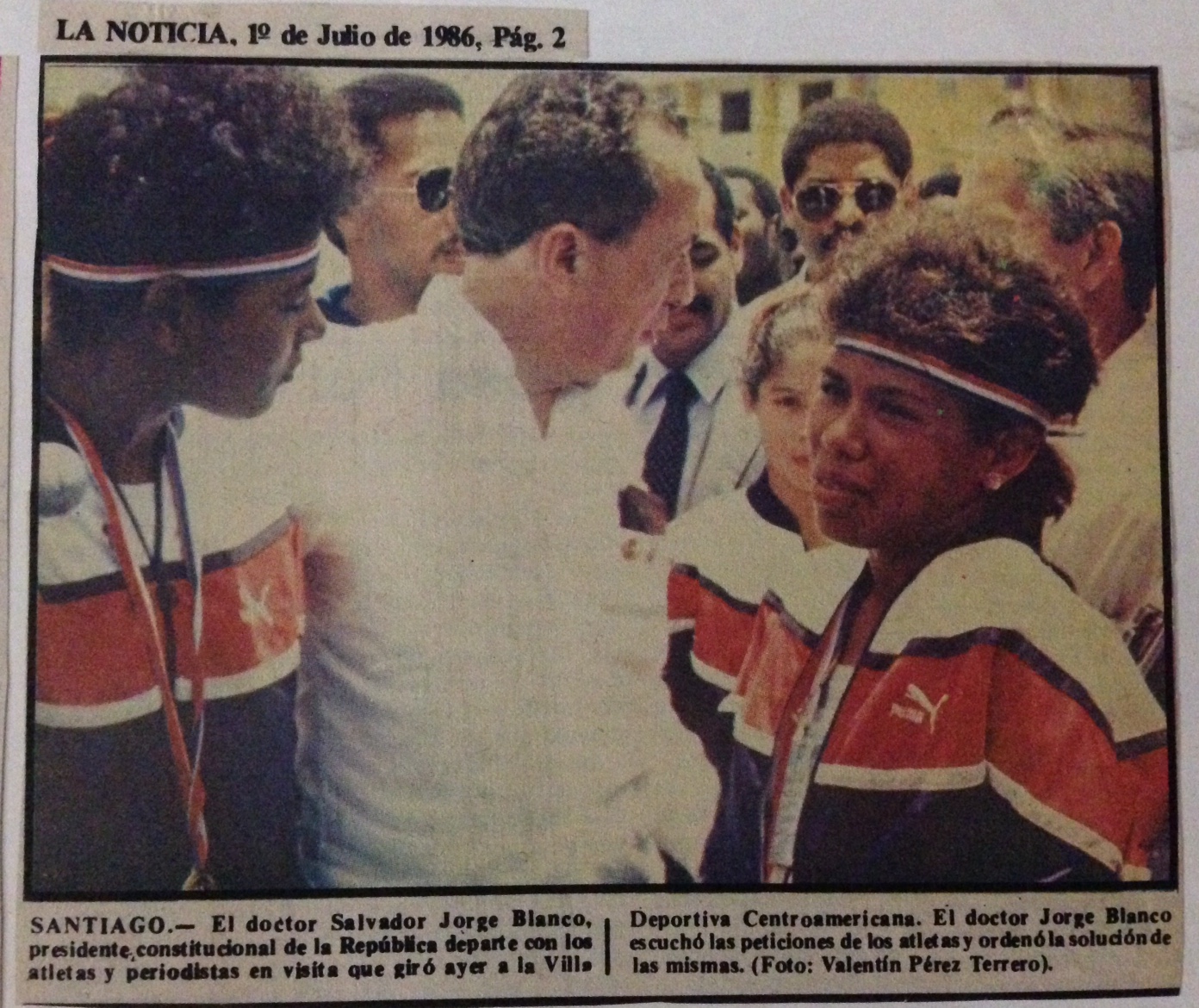
La euforia fue tanta que el propio presidente de la república, Salvador Jorge Blanco, en visita a las instalaciones de los juegos dispuso el ascenso inmediato de aquellos que siendo militares lograron preseas en las competiciones de judo.
 |
| Carlos Bermúdez, presidente del Comité Organizador |
Luego de esta proeza el judo dominicano no ha igualado esa participación a pesar de que se han agregado más opciones de medallas con la inclusión de las competiciones de Kata y por Equipos.
Como nota a resaltar está la contribución de la Embajada de Korea en el país que para la preparación del seleccionado dominicano trajo al país el experto internacional de nombre Kim Sung Soo.
 |
| Jaime Casanova Martínez, presidente de la Federación Dominicana de Judo (Fedojudo) |
Nuestro más elevado reconocimiento a esos atletas, entrenadores, personal técnico, árbitros, dirigentes, en fin, que en medio de todas las vicisitudes lograron superarse a si mismos y cambiaron la historia pues son ellos los verdaderos precursores del futuro del judo dominicano a partir de esa hazaña.
LOOR CAMPEONES!!!!!!!!!!!!!!!!!
Jaime Casanova Martínez.
24 de junio 2026.-.
__________________________________________________________________
Santo Domingo, Dominican Republic.– When the XV Central American and Caribbean Games began on June 24, 1986, at La Barranquita Stadium in Santiago de los Caballeros, Dominican Republic, the judo team, participating for the first time with both the women's and men's national teams, could not have predicted that this foray would mark the definitive rise of the sport in the country, judging by the medals won.
The Organizing Committee for these games was chaired by Carlos (Carlucho) Bermúdez. The president of the Dominican Olympic Committee (COD) at the time was Dr. José Joaquín Puello Herrera, the Secretary of State for Sports, Physical Education and Recreation (Sedefir) was Dr. Luis Scheker Ortiz, and the president of the country at the time was Dr. Salvador Jorge Blanco.
The games in question were not without their share of varied and unusual controversies, leading to several changes in their management and even requiring legal action to legitimize the measures taken by the Dominican Olympic Committee and thus guarantee the organization, setup, execution, and results of the events.
The then Central American and Caribbean Sports Organization (CACSO) was presided over by the Puerto Rican Germán Rieckehoff Sampayo, the regional governing body of the games, which were being hosted by the Dominican Republic for the second time.
The Dominican delegation to this major athletic event was headed by Professor Luis Elpidido Cumba, an experienced sports leader from the Olympic city of La Vega.
It is worth noting that the President of the International Olympic Committee, the Spaniard Juan Antonio Samaranch, honored us with his visit, marking the second time a president of this organization had visited the country. The first was the Englishman Lord Michael Morris Killanin, who visited for the 1974 Games, held under the motto "Commitment of All."
The official emblem featured a market vendor carrying the Olympic rings in her basket, and Chaguito, a donkey carrying a torch, was the mascot of these games, which were held splendidly in the Cibao region.
The Dominican judo delegation consisted of Luciano Luna, José Raposo, Víctor Calderón, Pedro Figueroa, Euclides Valdez, Felipe Morban, John Edwards Adams Pérez, and Desiderio Lebron, competing in the 55, 60, 65, 71, 78, 86, 95, and over 95 kg weight categories, respectively, all in the men's division.
The women's team included Ines González, Luisa Martínez, Judith Feliz, Judelkis Urbáez, Evelyn Adams, Andrea Hernández, Idalia Guridis, and Albania Rivera, competing in the 48, 52, 56, 61, 66, 72, over 72 kg, and open divisions, respectively.
Juan Chalas Jiménez and Radhames Lora Salcedo served as coaches, and Juan Chalas Mallen and Antonio Giraldez Casasnovas as delegates. Saadia Montolio de Chalas Jiménez coordinated the women's delegation.
Previously, Dominican judo had earned two bronze medals at these Central American and Caribbean Games, both won by Juan Chalas Jiménez in the previous regional editions held in Santo Domingo, Dominican Republic in 1974 and Medellín, Colombia in 1978.
History was on the side of the young leaders who, with just two years at the helm of the Dominican Judo Federation, had selected Jaime Casanova Martínez, Juan Chalas Jiménez, Santiago Cuesta Díaz, Desiderio Lebron, and John Edwards Adams Pérez as president, vice president, secretary, co-secretary, and treasurer, respectively.
It was in this edition that women competed for the first time, and they won two gold medals, one each from Inés González of Azua and Andrea Hernández of La Vega.
Albania Rivera won silver, and Luisa Martínez, Judelkis Urbáez, Evelyn Adams, and Idalia Guridis each took bronze.
In the men's division, Luciano Luna, Pedro Figueroa, and Euclides Valdez won silver, and José Raposo, John Edwards Adams Pérez, and Desiderio Lebron each won bronze. It's worth noting that John Adams Pérez won two bronze medals, competing in both his weight class and the open division.
Overall, Cuba took first place with a total of 299 medals, followed by Mexico with 133, Venezuela with 120, Puerto Rico with 93, Costa Rica with 14, Colombia with 69, and the Dominican Republic in seventh place with 70 medals: 9 gold, 34 silver, and 27 bronze.
The Dominican Republic's judo delegation at these games won 14 medals: two gold, four silver, and eight bronze, representing 20 percent of the total medals won by the national delegation at this important Central American and Caribbean sporting event.
Praise and accolades for the Dominican judokas were swift from the various media outlets covering the athletic competition, which featured 2,100 athletes from 25 participating countries across 25 disciplines. All highlighted the significant progress made by Dominican judo.
The euphoria was so great that the President of the Republic himself, Salvador Jorge Blanco, during a visit to the Games facilities, ordered the immediate promotion of those military personnel who won medals in the judo competitions.
At that time, the Argentine Sarkis Kaloghlian and the Brazilian Carlos Catalano Callejas, in their capacities as President and Technical Director of Refereeing, respectively, of the Pan American Judo Union, were involved throughout the judo competitions.
Since this feat, Dominican judo has not matched that level of participation, despite the addition of more medal opportunities with the inclusion of Kata and Team competitions.
Of note is the contribution of the Korean Embassy in the country, which brought international expert Kim Sung Soo to the Dominican Republic to prepare the national team.
The preparation of the National Judo Team involved the participation of several individuals and organizations, including the Dominican Olympic Committee, the State Secretariat for Sports, and the Royal Spanish Judo Federation, with its president, Mr. Luis Baguena Salvador.
Our highest recognition goes to these athletes, coaches, technical staff, referees, and administrators—in short, to all those who, despite all the challenges, managed to overcome their own limitations and change history. They are the true forerunners of the future of Dominican judo, starting with this feat.
CHEERS CHAMPIONS!!!!!!!!!!!!!!!!!
Jaime Casanova Martínez
__________________________________________________________________